


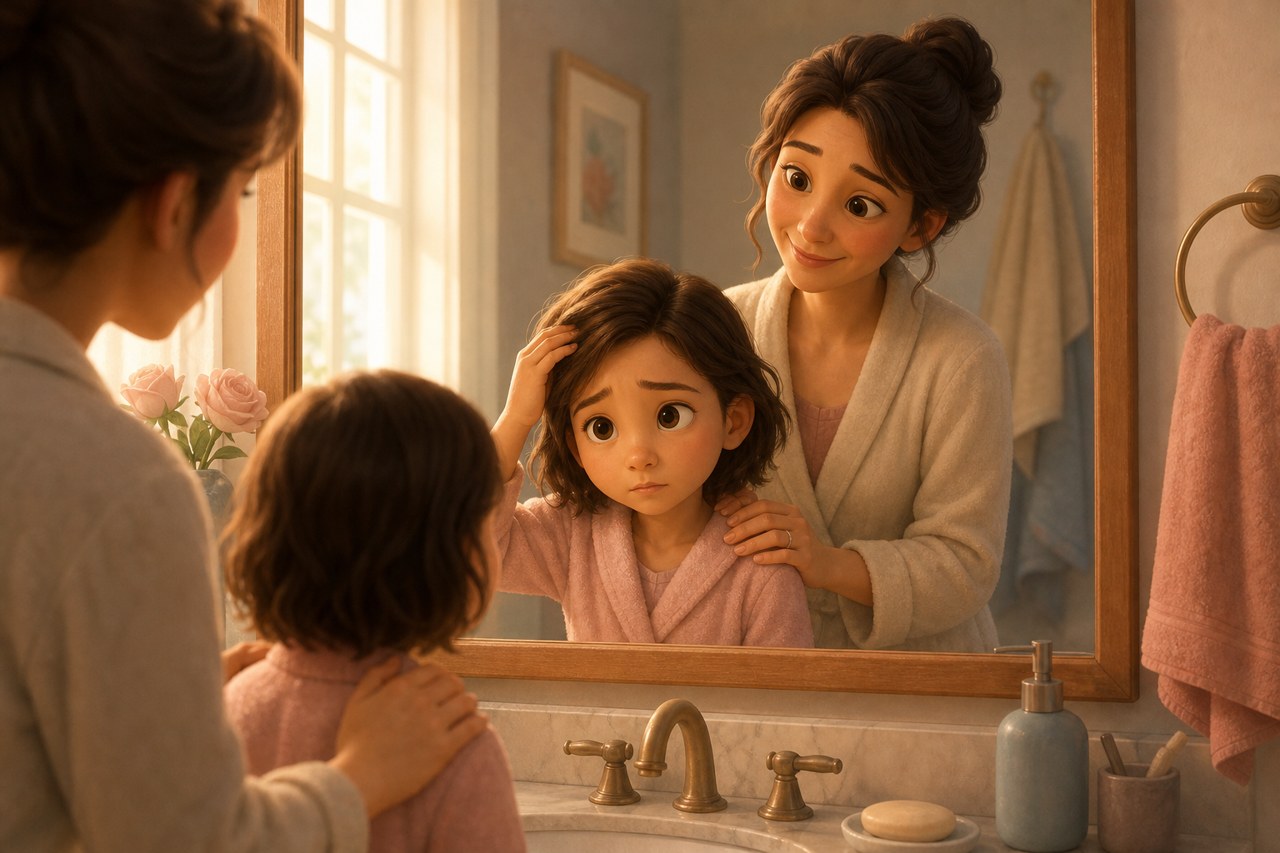
The flyer comes home in the folder: Picture Day is Friday! And somewhere between Tuesday and Thursday night, it starts.
She tries on four outfits and hates all of them. He asks if his ears look big. She wants to know if you can fix the tooth gap "before Friday." He announces he's going to do a fake smile on purpose so nobody can say his real one is weird.
School picture day looks like a logistics event. It's actually one of the earliest moments your child formally confronts a question that will follow them for decades: How do I look to other people — and how much does that decide what I'm worth?
Which means the morning of picture day is not really about hair. It's an identity conversation wearing a comb.
What do you say to a child who's worried about how they look on picture day? Don't argue with the worry ("you look fine!") and don't inflate it ("you're the most beautiful kid in that school!"). Both keep the frame that appearance is the thing being measured. Instead, move the frame: "That picture is so we can remember you this year — the kid who laughs at her own jokes and builds those Lego cities. The camera just catches the outside of all that." Then add the identity line: "You were made on purpose, exactly this face. It's a good face. It's yours."
Why this hits harder than it should
Somewhere around age six or seven, children discover the audience. They stop simply being and start watching themselves being watched — researchers see self-conscious emotions come online right in these years. Picture day lands directly on that developmental nerve: a formal moment where you sit alone, everyone looks at you, and the result gets printed, distributed, and pinned to a wall for a year.
Add the modern layer — kids who've grown up seeing filtered faces, retake culture, adults visibly managing their own angles — and a seven-year-old fussing about their smile isn't being vain. They're doing early rehearsals of a question the whole culture is going to keep asking them. Your voice in this rehearsal is the one they'll reuse.
What to say in the days before
When the outfit spiral starts:
- "Pick the one that feels most like you." Not the fanciest, not the most flattering — the most you. You're teaching them that presentation can express identity instead of performing for approval.
When they name the feature — the ears, the gap, the cowlick, the glasses:
- Don't rush to "nobody will notice!" (they'll hear: it IS noticeable, and we hope for the best). Try: "That gap is part of this exact year of you. In the picture from when you're grown, it's going to be one of my favorite things."
- And the anchor line, which is worth saying slowly: "God made your face on purpose. Every part. Nothing about it is a mistake to fix."
When they announce the strategic fake smile:
- "You can smile however you want. But I'll tell you a secret — your real one is the one I'd pick every time." Permission first, preference second. Pressure to "smile naturally!" is the fastest way to guarantee no one does.
What to say the morning of
Keep the morning boring. Extra fussing — the wet comb, the shirt re-tuck at the door, "let me look at you… okay, fix your collar" — reads as today your appearance is being graded. One pass on the hair, then done.
At the door, instead of "smile big!" try:
- "Have fun today. It's just a picture — it's not a test."
- "I already know what you look like. I'm just glad I get a copy."
That second one, delivered offhand, does something quietly enormous: it tells them the verdict is already in, and it was never pending.
When the pictures come back bad
They will, some year. Eyes half-closed, hair doing something structural, the smile a hostage photo. Your reaction is the actual curriculum:
- Laugh with, never at — and let them lead. If they think it's hilarious, it's hilarious. If they're crushed, it's not funny yet.
- "A weird picture doesn't mean you look weird. It means cameras catch one second, and some seconds are goofy. You are not a second."
- Resist the retake reflex. If your first move is scheduling retakes, ask yourself what that teaches. Sometimes the braver, better move is buying the goofy one, putting it on the wall with the others, and loving it out loud. A family wall with a few ridiculous photos on it is a wall that says you don't have to be perfect to be displayed here.
The picture that actually matters
Twenty years from now, that photo will surface in a box, and here's the strange thing: the gap teeth and the cowlick — the features they wanted to fix — will be the parts that make your chest ache with love. Nobody ever looks at an old school picture and wishes the child in it had been more polished.
Your child can't see that yet from inside the worry. So you hold it for them, out loud, every September: You were made on purpose. It's a good face. It's yours. And I'm just glad I get a copy.
Say it enough Septembers in a row, and when the culture eventually shows up with its filters and its verdicts, it'll find the seat already taken.
Keep going
- Bedtime Affirmations for Kids: 25 Phrases That Build Identity and Calm Anxiety — including "fearfully and wonderfully made," for the night before.
- Raising Secure Kids in the Age of TikTok — the longer game this morning is part of.
- 5 Phrases That Build Beloved Identity (And 5 to Avoid) — for every other morning.