


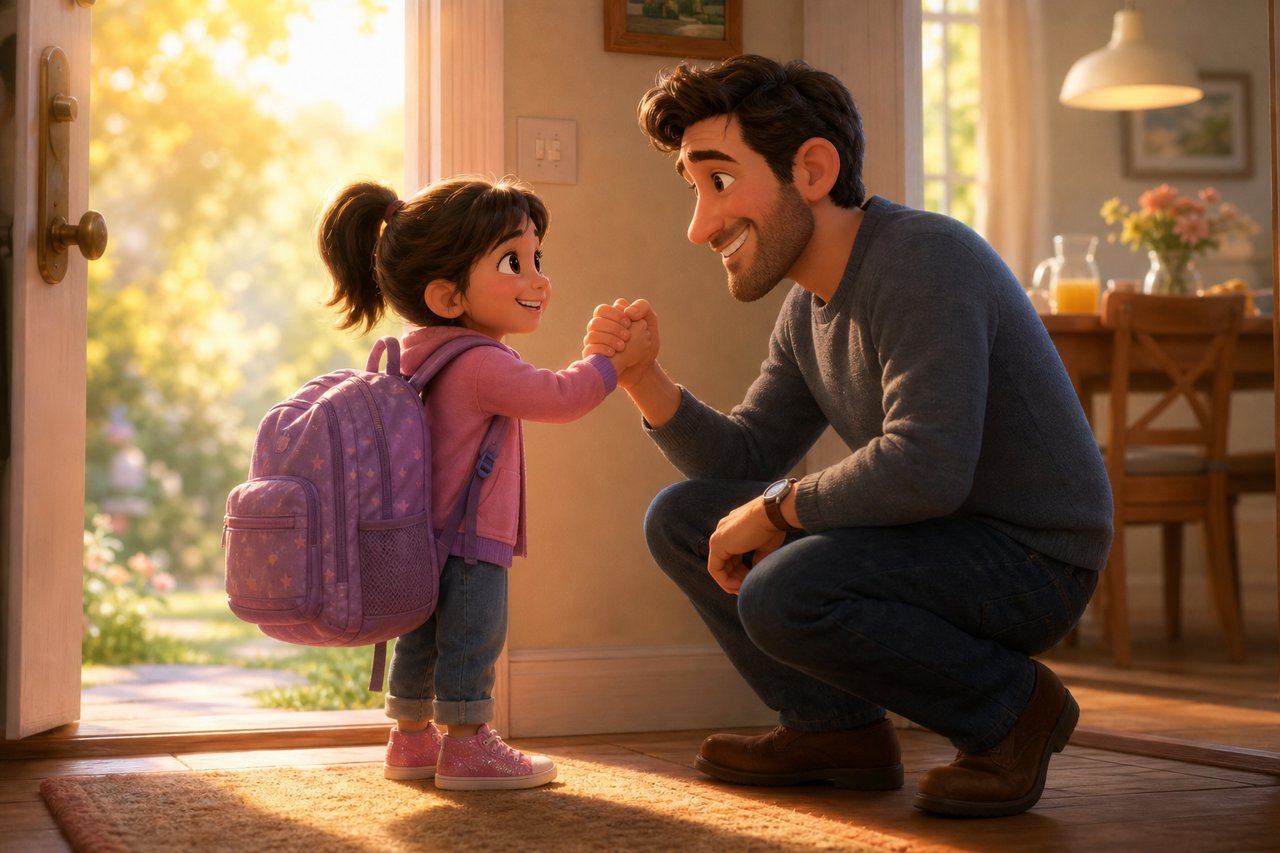
There will be a photo. The too-big backpack, the carefully chosen outfit, the little chalkboard sign if you're that kind of family. And behind the camera, a parent doing quiet math: five years went by in about eleven minutes.
The first morning of kindergarten is enormous for you and — here's the thing to hold onto — merely large for them. Your five-year-old isn't grieving the end of an era. They're wondering about way more practical things: where the bathroom is, whether their teacher is nice, and if you'll actually come back at pickup.
Which means the words that help are simpler than the moment feels. Here's the whole morning, beat by beat.
The rule underneath everything: nothing new today
Whatever your child needs to hear on the first morning, this morning is the wrong time to say it for the first time.
A nervous kid at 7am can't absorb a new idea — their working memory is full of backpack and butterflies. What they can do is replay something familiar. So the first morning is for pressing play on anchors you've already planted: the goodbye ritual you've practiced, the phrase they've heard all week, the plan you made together at bedtime.
If you haven't planted those yet and school starts tomorrow, do the bedtime conversation tonight — we've written that script here: what to say to an anxious child before the first day. Then this morning becomes the replay.
Breakfast: keep it boring (boring is love)
No special first-day pancake bar. No sibling photoshoot production. The more this morning resembles a regular morning, the more your child's nervous system files school under ordinary life instead of major event.
What to say at breakfast: mostly normal things. The weather. The cereal. One — exactly one — forward look, framed as certainty rather than hype:
"So today's the day you meet Mrs. Park. Tonight at dinner I want to hear one thing about your classroom. Just one — you pick."
That sentence does quiet work. It presumes they'll make it through (they will), gives them a tiny mission (find one thing to report), and schedules the reunion (dinner — a fixed point on the far side of the scary part). Kids handle hard middles better when the far edge is already real.
What to skip at breakfast: "Are you excited?? Are you nervous?? How are you feeling??" An anxious kid asked to report feelings at 7am will usually manufacture the ones you seem to be looking for. If they want to talk feelings, they'll bring it up — and then you listen. Otherwise: cereal, weather, one thing at dinner.
Getting dressed and out the door: hand them a job
Fear shrinks when a child has a mission. Somewhere between shoes and car, give them one:
"You're in charge of the backpack today. It rides on your back, it hangs on your hook — you're the backpack boss."
Or, for the tender-hearted kid:
"Here's your job today: find one kid who looks a little scared and smile at them. That's it. You're really good at that."
The second one is quietly brilliant for anxious kids: it converts I'm scared into I'm the helper for scared people — same feeling, completely different seat. That's an identity move (tell them who they are — the helper, the noticer — and they'll act like it).
In the car or on the walk: the replay
This is where the pep talk usually happens, and where it usually misses. "You're going to do GREAT! Best day EVER!" sets a performance bar — and if the day is merely okay, or has a rough hour, your child comes home having failed the prophecy.
Bless instead. A blessing has no bar to clear — it's true regardless of how the day goes:
"Remember what we said: you're brave — that means going even with butterflies. You're kind — kind kids always find their people. And you are already loved, the whole day, the whole time. Nothing that happens today changes that."
Then let there be quiet, or music, or their favorite dumb joke. You don't need to fill the drive. The words are planted; silence lets them settle. (If those three phrases sound familiar, it's because repetition is the entire strategy — the same true words, again and again, become their inner voice. Day one of kindergarten is that voice's first field test.)
At the door: short, same, sure
Kindergarten drop-off on day one is its own weather system — teachers in bright shirts, name tags, a hallway of wobbling parents. Your part takes ninety seconds:
- Crouch to eye level. Big moments happen at their altitude, not yours.
- One sentence: "This is going to be a good one. See you right after outside time — I want my one thing at dinner."
- The ritual: the handshake, the two squeezes, the kiss on each cheek — whatever you've practiced. Same one, every day, all year.
- Hand off and go. Warm, unhurried, finished. No hovering at the window. Lingering tells them even you're not sure about this place.
If there are tears — and for lots of wonderful kids there are — the script changes by one sentence, not ten. Validate and anchor: "Saying goodbye is hard, huh? It's okay to feel sad — and you're going to be okay." Then ritual, handoff, go. We've written the full crying-at-the-door playbook here: what to say when your child cries at drop-off. The short version: short, same, sure — and never sneak away.
In the car afterward: the part nobody scripts for you
You did the calm face. You did the ritual. You walked out like a champion. And now you're in the driver's seat blinking hard at a steering wheel.
Go ahead. This is the designated area.
Then, before you drive off, one more truth — this one's for you: your child is not sitting in that classroom missing you the way you're missing them. Within minutes, most kindergarteners are absorbed in the sheer novelty of it — the blocks, the carpet squares, the kid with the dinosaur shirt. The ache is real, and it is almost entirely yours. That's not sad; that's the design. You built a child secure enough to walk into a new world and get busy living in it.
Tonight: close the loop
The first morning gets all the attention, but the first evening is where the day gets its meaning. At dinner, collect your one thing. Don't interrogate ("Who did you play with? Was everyone nice? Did you eat your lunch?") — just the one thing, and whatever else spills out after it.
And at bedtime, seal it:
"You did it. You walked into a brand-new place full of brand-new people, and you did the whole day. That's what brave looks like — I hope you felt it. And whether today was wonderful or wobbly or both: you are loved. You were loved the whole time you were there. You always will be."
Then tomorrow morning, you do it all again — shorter, easier, more ordinary. By Friday it's routine. By October you'll barely remember the butterflies.
The too-big backpack, though — that part goes fast. Take the photo.