


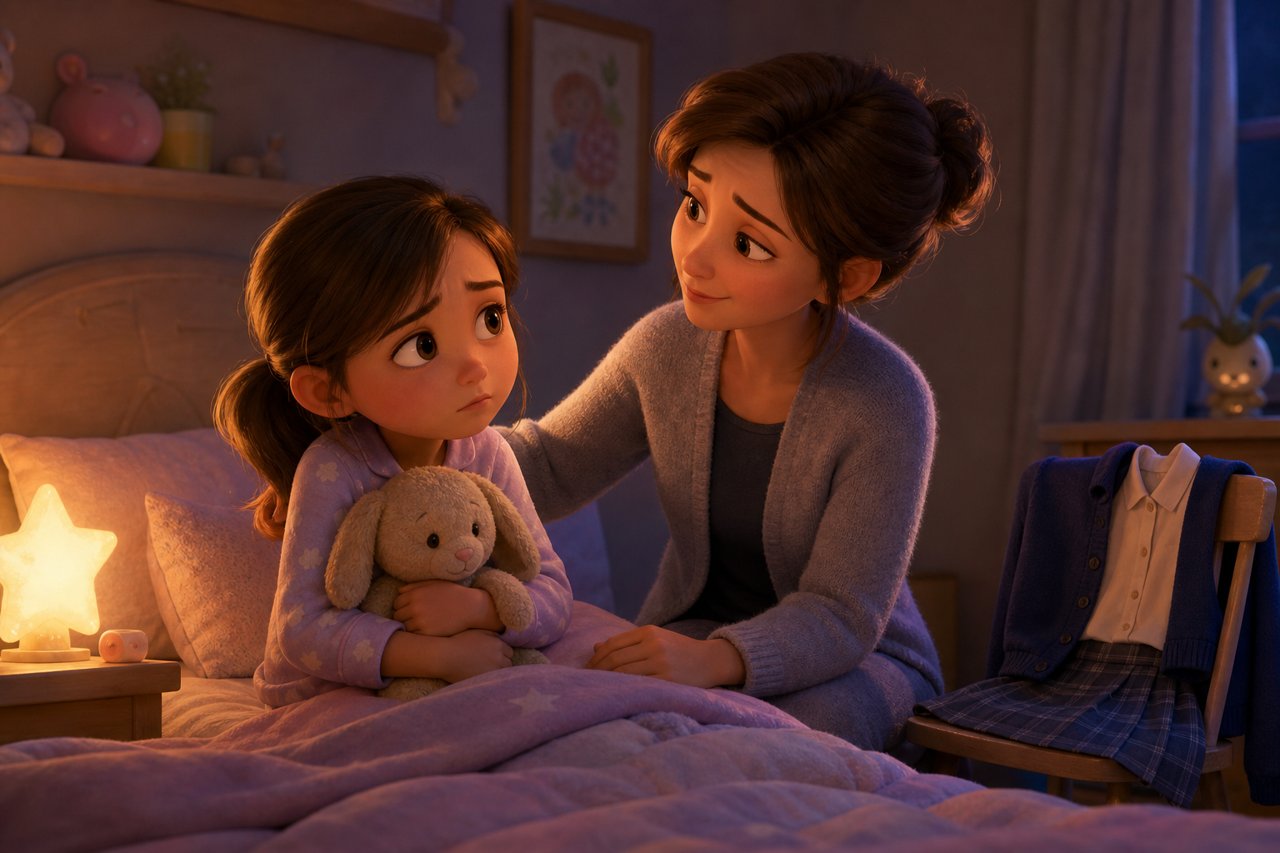
It usually shows up at bedtime, a few nights before school starts. The stalling. The extra glass of water. And then, small-voiced, from under the blanket: "What if nobody plays with me?"
Every parent knows the reflex: "You'll be fine! You're going to love it!"
It's said with total love. And it almost never works — because to an anxious child, "you'll be fine" doesn't sound like comfort. It sounds like the feeling I'm having right now is wrong. Now they're anxious and alone with it.
Here's the reframe that changes everything: your job the week before school isn't to remove the fear. It's to make sure the fear isn't the biggest thing in the room. Fear shrinks when it stands next to something more solid — and the most solid thing a young child has is who they are to the people who love them.
Why first-day fear is actually reasonable
Start here, because it changes your tone: your child's anxiety is not a malfunction. A five-year-old walking into a new classroom is facing real unknowns — a stranger in charge, twenty unfamiliar kids, rules nobody has explained yet, and no way to reach you for six hours.
Underneath every specific worry ("what if I can't find the bathroom?") sits the deep question every child is quietly asking: Will I be okay here? Am I still loved and wanted in a place where nobody knows me yet?
That's an identity question wearing a logistics costume. Which is why logistics answers ("the teacher will show you the bathroom") help a little, and identity answers help a lot.
The night before: a four-step conversation
Bedtime the night before school is the highest-leverage ten minutes of the whole week. Wound-up kids talk at bedtime — the lights are low, the day is over, and the guard comes down. Here's the shape that works, in order:
1. Let the fear speak — and agree that it makes sense
"You've got some big feelings about tomorrow, huh? Tell me the scariest part."
Then — this is the part most of us skip — validate before you reassure:
"Yeah. It makes sense you'd feel that way. New places are like that, even for grown-ups. I get butterflies when I start new things too."
You haven't fixed anything yet. You've done something better: your child now knows the fear is speakable and they're not weird for having it. A named fear is already a smaller fear.
2. Anchor identity: what doesn't change tomorrow
Now put something underneath them:
"Here's what I know. Tomorrow, everything around you will be new — new room, new teacher, new kids. But you won't be new. You'll be the exact same Ella you are right now in this bed. Loved by us. Loved by God. Made on purpose. That part doesn't stay home tomorrow — it walks in with you."
This is the sentence anxious kids actually need, because it answers the real question. Not will tomorrow be easy — you can't promise that — but will I still be me, still be loved, in the scary place? That you can promise. (This is the same principle behind why we tell them who they are before the world does — the first day of school is simply the world's opening bid.)
3. Give the fear one plan
Anxiety shrinks when it has a job to do. Take their scariest specific moment and build one tiny plan:
"So — if you can't find anyone to play with at recess, here's the plan. You find one kid who's also alone, and you say, 'Want to play?' That's it. That's the whole plan. And if it doesn't work, you try one more kid, and then you tell me all about it at pickup and we'll make a new plan together."
One fear, one plan. Not ten plans for ten fears — that reads as there's so much to be afraid of. Ask them which moment worries them most, and plan for that one.
4. End with a blessing, not a pep talk
Pep talks are about performance ("You're going to do great!"). Blessings are about identity. Anxious kids can fail a pep talk; they can't fail a blessing.
"You are brave — not because you're not scared, but because you go anyway. You are kind, and kind kids always find their people. And no matter what happens tomorrow, you are already loved. Nothing about tomorrow can change that."
Keep it short enough that they can replay it in their head at 10am when the room feels big. Repetition is the whole mechanism here — the same words, night after night, become the voice they hear when you're not there.
The morning of: less is more
Morning-of is not the time for the big conversation — anxious kids can't absorb it while their stomach is flipping. The morning has three jobs:
- Keep it boring. Predictable breakfast, no rush you can avoid, no surprise errands. Calm is contagious; so is chaos.
- One-line replay of the blessing. "Remember: brave, kind, already loved. Same kid there as here." That's it. You're pressing play on last night's recording, not making a new one.
- A goodbye ritual with a hard edge. Anxious kids do worse with long, lingering goodbyes — the lingering says even Mom thinks this is dangerous. Pick a ritual (two squeezes of the hand, a kiss on each cheek, a secret handshake), do it with full attention, and then leave warmly and confidently. If the tears come at drop-off anyway — many kids cry at the door and are playing happily eleven minutes later — that's normal, and we've written a whole companion piece on what to say when your child cries at the school door.
What not to say (and what to swap in)
| Instead of… | Try… |
|---|---|
| "You'll be fine!" | "It makes sense to feel nervous. And you can feel nervous and be okay at the same time." |
| "There's nothing to be scared of." | "Tell me the scariest part. Let's make a plan for that exact moment." |
| "Big kids don't cry about school." | "Even brave kids get butterflies. Brave means going anyway." |
| "Don't embarrass me at drop-off, okay?" | "When it's time to say goodbye, we'll do our handshake, and then you've got this." |
| "Be good for your teacher!" | "Be you for your teacher. That's plenty." |
The pattern: every left-column line asks the child to hide the feeling. Every right-column line lets the feeling exist while keeping the child bigger than it. ("Be good" has its own problems all year round — here's why, and what works instead.)
For the kid whose anxiety is louder
Some kids aren't butterflies-and-a-brave-face; they're stomachaches, meltdowns, "I'm not going" with arms crossed. If that's your child, three additions:
- Start earlier. Do the four-step conversation several nights running, not just the night before. Each pass makes the fear more familiar and the anchor more automatic.
- Shrink the unknowns you can. Walk the hallway at open house. Find the bathroom together. Practice the lunchbox latches. Every solved logistic is anxiety with one less costume to wear.
- Watch your own face. Anxious kids read parents like weather radar. If your goodbye face says I'm worried about you, no script will out-talk it. And if you suspect a good chunk of the anxiety in the house this August is actually yours — that's common, it's human, and we wrote a whole companion piece for you: your back-to-school anxiety is not about school. Kids read state, not speeches; calming yourself is a legitimate parenting strategy.
And if the anxiety is severe, persistent, or getting worse rather than better after the first weeks, loop in the pediatrician or school counselor. Words at bedtime are powerful; they're not meant to do that job alone.
The long game: identity before the world weighs in
Here's the thing about the first day of school: it's the first of many rooms your child will walk into without you. New grades, new teams, new lunch tables, someday new cities. You can't be in those rooms.
But your voice can — if it's been repeated enough to become their voice.
That's the entire reason bedtime matters so much in our house, and it's why we built a personalized book that tells your child, by name, that they are already loved — the same identity truths, every night, until they're not something your child hears but something they know. The first day of school is exactly when you find out what's been planted.
Fear says: What if nobody there loves me? Identity, planted deep, answers: Someone already does. I can go find friends on top of that.
That's the kid who walks in on the first day — not unafraid, but anchored. And anchored is better than unafraid. Anchored lasts.