


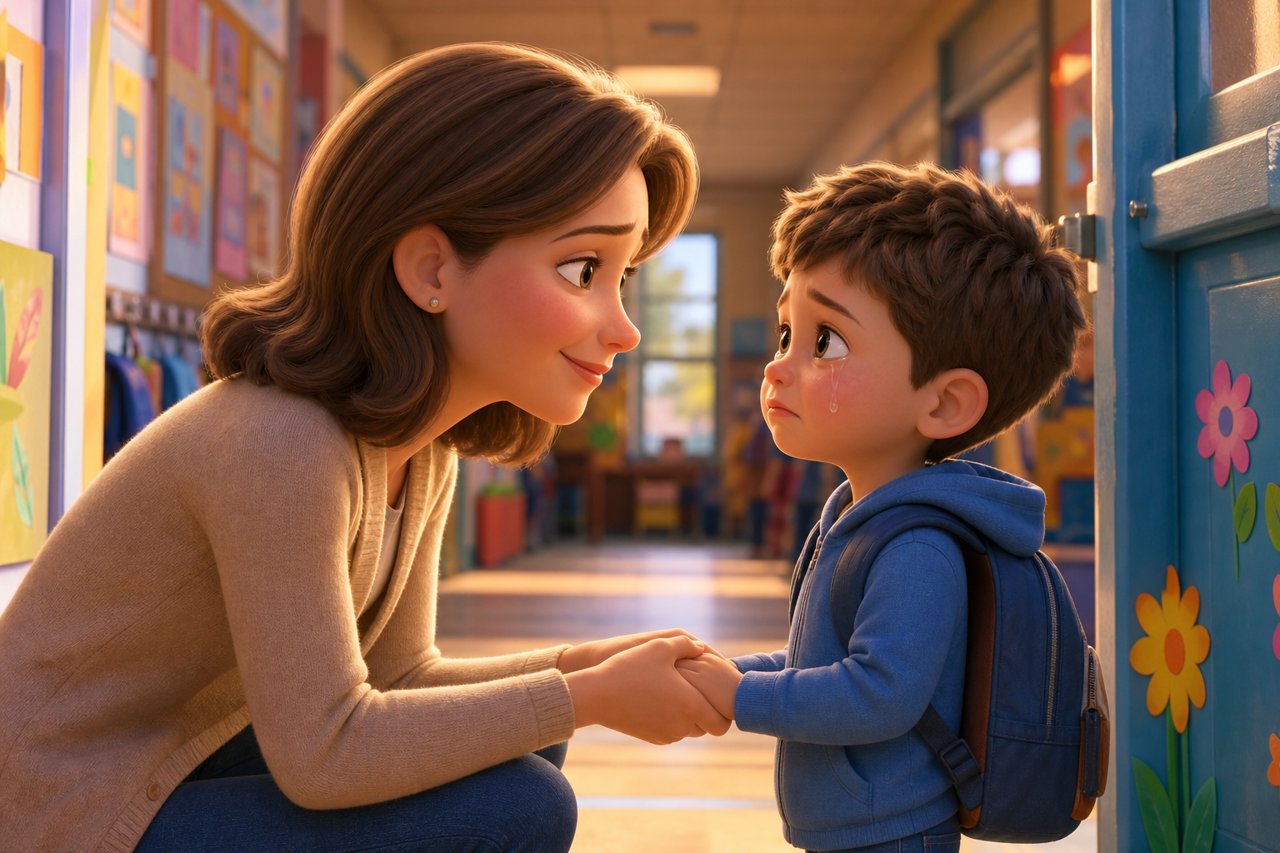
There is a specific kind of parental heartbreak that only happens between 7:50 and 8:10 on a school morning: your child's arms locked around your leg, their face crumpling, a teacher gently prying fingers loose while you walk away from the sound of your own child crying your name.
You get in the car. You sit there. You wonder if you're doing permanent damage.
Let's start with the answer to that: you're not. Drop-off tears are one of the most normal, most researched, most temporary struggles in early childhood — and there is a way to handle the moment that genuinely shortens it. Not a trick. A script, a ritual, and one piece of work that happens twelve hours before the door.
What drop-off tears actually are
Here's the reframe that helps most parents exhale: a child who cries when you leave is a child whose attachment system works.
Your child has spent their whole life learning one big lesson: you are safety. Now they're being asked to watch safety walk away, into a building full of strangers, with no sense of when six hours ends (young kids genuinely can't feel the difference between "after lunch" and "next week"). The crying isn't manipulation and it isn't fragility. It's a healthy alarm going off in a situation the alarm doesn't understand yet.
Two facts every crying-kid parent should have taped to the dashboard:
- Most criers recover fast. Teachers see it every single day: the child who was sobbing at 8:03 is doing puzzles with a new friend at 8:14. The tears are about the transition, not the school. Ask the teacher what the ten-minutes-later picture looks like — the answer is usually the most reassuring sentence you'll hear all week.
- Consistency shortens it. Handled the same calm way every morning, drop-off tears typically fade over days to weeks. What extends them is unpredictability — different goodbyes, different lengths, different faces on the same parent.
The goodbye that works: short, same, sure
If you remember three words in the moment, make them these: short, same, sure.
Short
The hardest instruction in parenting: when your child cries, don't linger. Every extra minute of hugging, re-explaining, and one-more-kissing doesn't soothe the fear — it confirms it. A child reads a lingering parent perfectly: even Mom isn't sure I'm safe here.
Ninety seconds, start to finish. It will feel too short to you. It is exactly right for them.
Same
Build a ritual and run it identically every morning:
Walk to the door → crouch to eye level → one sentence (below) → the ritual move (two hand-squeezes, kiss-on-each-cheek, secret handshake — pick one, keep it forever) → "See you at pickup, right after outside time" → hand to teacher → leave.
The ritual does the emotional heavy lifting because it's predictable. Predictable = survivable. Kids stop fearing what they can rehearse. Say pickup in kid-time ("right after outside time"), never clock-time — clocks mean nothing at five.
Sure
Your face is the forecast. If you look worried, the day is dangerous; if you look calm and warm, it's survivable. So say the goodbye like you'd say "see you after your nap" — full of love, empty of doubt. If you need to cry, the car is twenty feet away and it works fine for that. (Truly — cry in the car. It's practically a parenting sacrament.)
The one sentence for the moment
While the arms are around your leg, you have room for about one sentence. Make it this shape — validate AND anchor, never either alone:
"Saying goodbye is hard, huh? It's okay to feel sad — and you're going to be okay. You're brave, you're kind, and you are so loved. Squeeze-squeeze — see you right after outside time."
Why both halves matter:
- Validation alone ("I know, it's so hard, I know, I know…") sinks into the sadness with them and stalls the exit.
- Reassurance alone ("You're fine! Big girl!") tells them the feeling is wrong, which adds shame to fear — now there are two problems. (The same reason "be good" backfires: it addresses behavior while the identity question goes unanswered.)
- Together — this feeling is real AND you are okay — they teach the actual lesson of drop-off: feelings and safety can coexist. That's emotional regulation in one sentence, and they'll use it for the rest of their lives.
What never helps (though we've all done every one)
- Sneaking out. The tears stop today — and tomorrow your child watches you like a hawk all morning, because parents disappear now. Sneaking away trades one cry for weeks of vigilance. Always say goodbye, even when a clean escape is right there.
- Bribing. "If you don't cry, ice cream after school" teaches that the tears are currency and the feeling is for sale. It also collapses the moment it fails, which is Tuesday.
- Pleading. "Please don't cry, please, for Mommy?" hands your five-year-old responsibility for your feelings at the exact moment they're drowning in their own.
- Threatening or shaming. "The other kids aren't crying." Now they're scared and less-than. The fear will not surrender to embarrassment; it will just go underground and come back as stomachaches.
- The double return. You leave, they wail, you come back "just for one more hug." You've just taught them the exact volume that reverses a goodbye. The kindest thing your child can learn at the door is that goodbye means goodbye — and that you always, always come back at pickup.
One more, for you: don't grade yourself by the tears. A crying drop-off you handled with calm, warm consistency is a successful drop-off. The metric isn't dry eyes today; it's shorter tears by Friday.
The real fix happens at bedtime
Here's the part most drop-off advice skips entirely: the door at 8am is the worst possible place to build your child's sense of safety. They're flooded, you're rushed, and the bus is honking.
The best place is twelve hours earlier, in the dark, in the two square feet of a bed — where the same child who couldn't let go of your leg is calm, close, and listening. This is when you plant what the morning will need:
"Today when I left, it felt scary, and you did it anyway. That's what brave is — going anyway. And here's the thing that's true every single day: you are loved the whole time you're at school. My love doesn't drive away with the car. God's love doesn't wait in the parking lot. It stays with you — at your table, at recess, everywhere. Same kid, same love, all day."
Then repeat it. Tomorrow night and the next. Not new speeches — the same one. Repetition is how a parent's voice becomes a child's inner voice, and the inner voice is who talks to your child at 8:03am when you can't.
That's the deepest reason we're such believers in bedtime around here — and why we made a personalized book that tells your child by name, every night, that they are already loved. A child who falls asleep hearing you are loved, you are wanted, you are safe carries a different sentence to the school door than the child who's only hoping it's true. The door is where you find out what bedtime has been planting. (If first-day worries are the bigger battle right now, start with what to say before the first day — it's the companion to this piece.)
When to look closer
Most drop-off tears fade with consistency inside a few weeks. Talk to the teacher and your pediatrician if the distress is escalating after several weeks instead of easing, if it comes with big changes in sleep, eating, or play at home, or if your gut simply says something more is going on. Asking is free, and teachers have seen a thousand drop-offs — they know the difference between a hard transition and a red flag.
The car-line summary
- Tears at the door = healthy attachment + new situation. Normal. Temporary.
- Short, same, sure: ninety seconds, identical ritual, confident face.
- One sentence: validate AND anchor. "Goodbye is hard — and you're going to be okay. Brave, kind, already loved."
- Never sneak, bribe, plead, or shame. Always come back at pickup, on time, every time.
- Plant safety at bedtime, where they can actually hear it. The morning harvests what the night plants.
And when you make it back to the car after a hard one: hand on heart, deep breath. You didn't damage anything. You walked your child through one of their first big feelings and showed them it was survivable. That's not a bad morning.
That's the job, done well.