


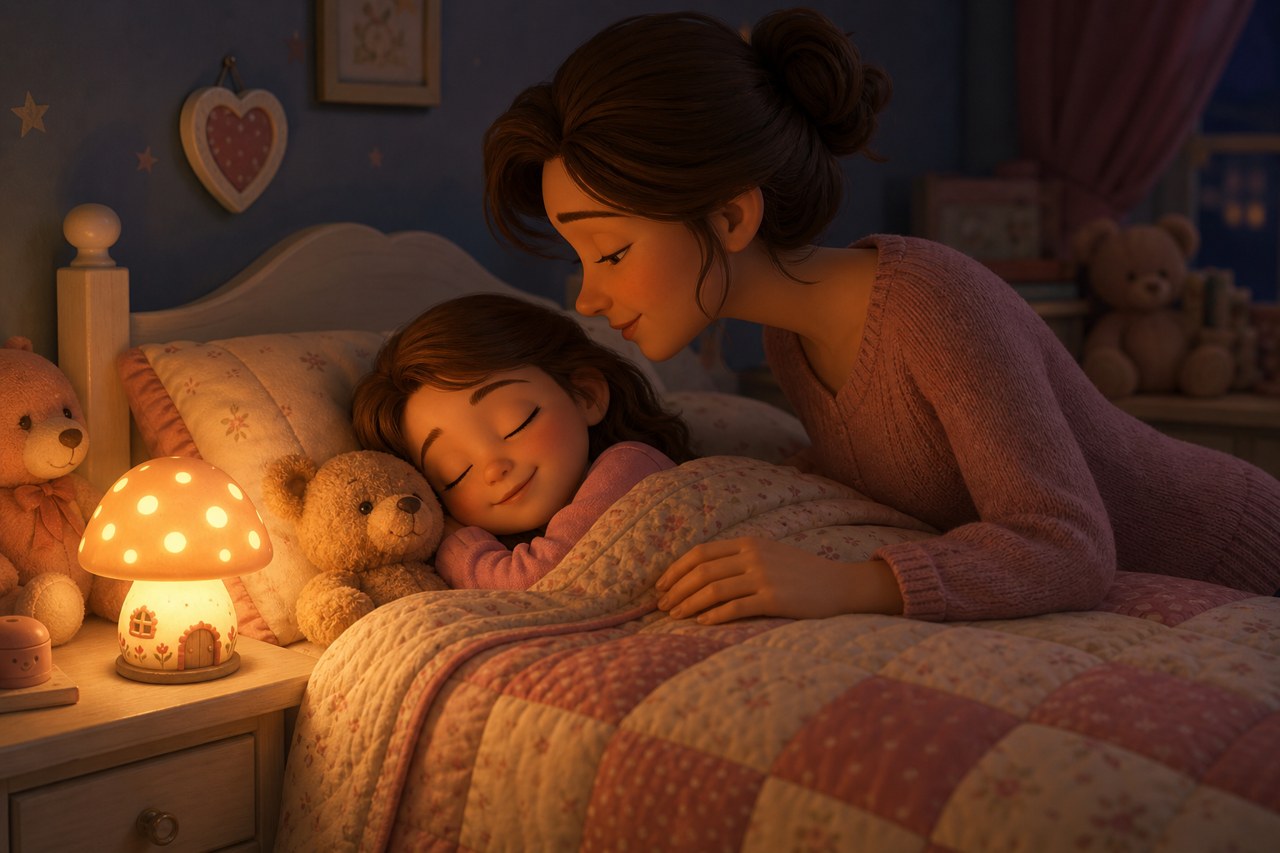
It's 8:47pm. The lights are off, the covers are up, and your child's brain is doing the thing it does every night: replaying the day. The friend who didn't share. The math worksheet that felt impossible. The moment you raised your voice in the car.
Anxiety loves a quiet, dark room. But so does identity.
Bedtime is the one window of the day when your child's defenses are down and their heart is wide open. Whatever gets spoken in those last 90 seconds doesn't just end the day — it gets carried into sleep, where the brain consolidates it into memory. That's why bedtime affirmations work when a hundred daytime pep talks don't.
Researchers who study children's self-talk keep landing on the same finding: the inner voice a child uses at 15 sounds remarkably like the outer voices they heard at 5. The words don't just comfort in the moment — they get rehearsed during the day's quietest handoff and stored. Which means the 90 seconds before sleep aren't small. They may be the highest-leverage parenting minutes you get all day, and they cost you nothing but a handful of true sentences.
This is a phrase bank, not a script. Below are 25 bedtime affirmations organized by what your child needs most tonight — belonging, calm, courage, repair, or faith. Pick one or two. Say them quietly, in your own voice, with their name. Repeat the same ones for weeks. Repetition is the point.
What makes a bedtime affirmation work? A bedtime affirmation works when it names who your child is, not what they did. "You worked hard today" is feedback — it evaporates. "You are brave, and you were made on purpose" is identity — it becomes the voice your child uses to talk to themselves. Keep it under ten words, say it in second person, and anchor it to something that doesn't change with behavior.
1–5: Belonging phrases (start here)
Every child's deepest bedtime question is some version of "Am I safe, and am I wanted?" These five answer it directly. If you only ever use one group, use this one.
- "You belong in this family — always, no matter what."
- "There is nothing you could do to make me stop loving you."
- "I'm so glad God gave me you."
- "You are already loved. You don't have to earn it."
- "Being your mom (or dad) is one of my favorite things about my life."
Notice what's missing: any reference to today's behavior. Belonging phrases work precisely because they're unconditional. On the hard days — especially on the hard days — these are the ones to reach for.
6–10: Calming phrases (for the anxious night)
Anxiety in children often shows up at bedtime because it finally has room to surface. These phrases don't argue with the fear ("there's nothing to be scared of" rarely lands). They out-anchor it.
- "You are safe. I'm right here, and God never sleeps."
- "Your body can rest now. Nothing on your worry list is yours to carry tonight."
- "Big feelings pass. You have gotten through every hard day so far."
- "It's okay to feel scared and be safe at the same time."
- "You can borrow my calm until yours comes back."
A practical note: say these slower and quieter than feels natural. A calming affirmation delivered at daytime speed reads as instruction. Delivered at half-speed in the dark, it reads as truth.
11–15: Courage phrases (for the night before a hard day)
First day of school. The spelling test. The friend situation. When tomorrow is the thing keeping them awake, speak to who they are, not just what will happen.
- "You are braver than the thing you're worried about."
- "You don't have to be the best tomorrow. You just have to be you."
- "New things feel wobbly for everyone — even grown-ups. Wobbly is not the same as wrong."
- "Whatever happens tomorrow, you come home to people who love you."
- "God goes ahead of you. Tomorrow is not a surprise to Him."
Number 14 is quietly powerful for school-age kids: it converts tomorrow from a test into a round trip. The day can go badly and their world still holds.
16–20: Repair phrases (for the day that went wrong)
Maybe they melted down. Maybe you did. Repair phrases are how a hard day ends in connection instead of shame — and they're the group most parents skip, because they require going first.
- "Today was hard, and you are still good."
- "I'm sorry I yelled. My frustration was about me, not about who you are."
- "Everyone has days like today. It doesn't change anything true about you."
- "Tomorrow is brand new. We get to start again — both of us."
- "Nothing that happened today made you less loved."
If you only remember one sentence from this whole article, make it #16. "You are still good" severs the link between a bad day and a bad self — the exact link that hardens into shame when it goes unaddressed.
21–25: Faith phrases (identity with an anchor)
These root your child's worth in something sturdier than mood, performance, or peer approval. Small words, deep foundation.
- "God made you on purpose, and He doesn't make mistakes."
- "You are God's beloved. That was true before you were born, and it's true tonight."
- "God knows your name and He delights in you."
- "You are fearfully and wonderfully made — every part of you."
- "God's love for you doesn't get bigger when you're good or smaller when you're not. It's already full."
How to actually use these (the 90-second routine)
Don't try to say ten of them. Affirmation soup washes over a child; one phrase, repeated nightly, sinks in. Here's a rhythm that takes about 90 seconds:
- Name and belong. Start with their name and one belonging phrase (#1–5).
- Meet tonight's need. Add one phrase from whichever group fits the day — calm, courage, or repair.
- Anchor it. Close with a faith phrase if that's part of your family's life.
- Stop. Resist the urge to teach, recap the day, or add "...so tomorrow let's try to...". An affirmation with a lesson attached is a lesson.
Then repeat the same three phrases for a month. When your child starts finishing the sentence for you — or you overhear them saying it to a stuffed animal — it's working. The goal was never variety. The goal is that these words become the voice in their head.
Do bedtime affirmations really help with anxiety?
Yes — with the right expectations. Affirmations aren't a treatment for an anxiety disorder, and a child whose worry regularly disrupts sleep, school, or friendships deserves support from a pediatrician or counselor. But for the ordinary anxiety of childhood — the replaying brain, the night-before nerves, the "was I bad today?" spiral — a repeated bedtime phrase does two real things: it gives the brain a familiar, safe sentence to settle on instead of the worry loop, and it pairs the last moments of the day with connection instead of review. Sleep researchers have long observed that pre-sleep emotional state shapes how memories consolidate overnight. What your child falls asleep hearing, they wake up believing a little more.
What NOT to say at bedtime
A few well-meaning phrases that quietly work against you:
- "Don't worry." Dismisses the feeling without out-anchoring it. Try #9 instead.
- "You were so good today!" Ties the day's closing verdict to behavior — which teaches kids to ask was I good? instead of am I loved?
- "Tomorrow, let's work on..." Coaching. Save it for daylight.
- "Go to sleep, everything's fine." Ends the conversation right when the real question was about to surface.
The pattern behind all four: they respond to behavior or emotion. Affirmations respond to identity.
You will not do this perfectly. Some nights you'll be too tired and the words will come out flat. That's fine — this practice runs on repetition, not performance. One true sentence, most nights, in your voice.
Because the world is going to spend the next few decades telling your child who they are. Bedtime is where you get there first.
Keep going
If this practice resonates, these go deeper:
- 7 Ways to Speak Identity Over Your Child at Bedtime — the full 60–90 second bedtime framework these phrases plug into.
- Why Bedtime Is the Perfect Time to Plant Identity — the brain science behind why this window matters so much.
- 5 Phrases That Build Beloved Identity (And 5 to Avoid) — daytime companions to the list above.
And if you want the words to outlast the season — something your child can hold, with their own name inside — that's exactly why we make what we make at AlreadyLoved.