


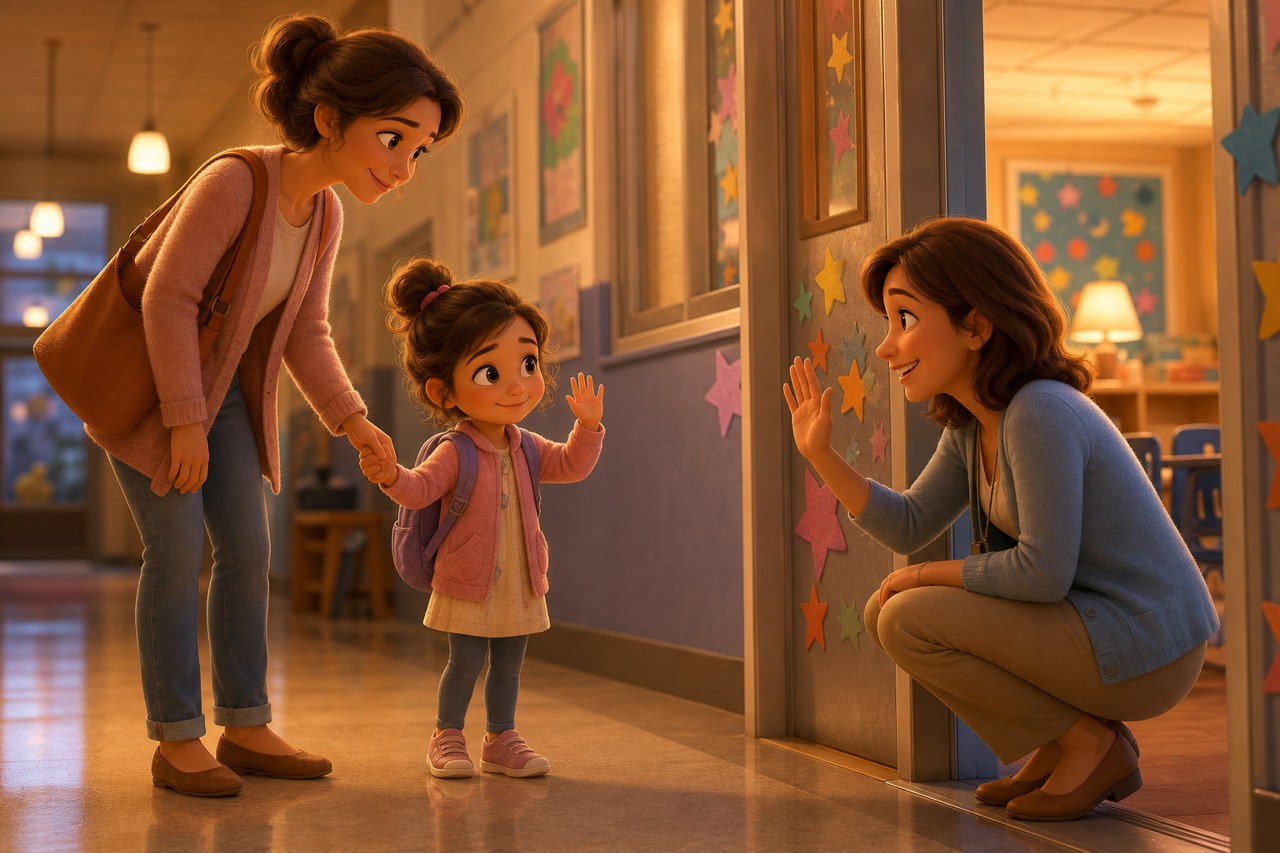
Somewhere between the supply list and the first-day outfit sits a small event that shapes your child's whole year more than either: Meet the Teacher Night.
It's twenty minutes in a classroom that smells like fresh crayons. And for your child, it's the first answer to the question underneath every new school year: Will I be known here?
Most parents walk in focused on logistics — where's the cubby, what's the pickup procedure, does she know about the allergy. All worth covering. But the real work of the evening is different: you are introducing your child to the person whose voice they will hear more hours a day than yours, and you get to set the frame for how your child understands that relationship.
Here's what to say — before, during, and after — to do that well.
What should you say to your child before Meet the Teacher Night? Keep it simple and belonging-focused: "Tonight we get to meet your teacher — she's been getting your classroom ready for you." That one sentence reframes the event from an inspection ("will I be okay there?") to a welcome ("a place has been prepared for me"). Avoid hype ("it's going to be AMAZING!") and avoid prosecution-prep ("make sure you shake hands and speak clearly") — both raise the stakes for a child who's already nervous.
Before you go: set the frame
In the car or at dinner beforehand, three sentences do most of the work:
- "Your teacher has been setting up that classroom all week — for you and your friends." A prepared place is a powerful idea for a child. They're not intruding on an adult's territory; they're expected.
- "You don't have to perform tonight. You can be shy, you can be loud, you can just look around. All of it's fine." Releasing the performance expectation before you walk in is a gift — especially for the slow-to-warm-up child.
- "I'll be with you the whole time." Obvious to you. Not obvious to them.
During: let your child be the one who's known
The instinct is to manage the interaction — prompt the handshake, answer for them, apologize for their shyness. Every one of those moves tells your child you're not doing this right. Try these instead:
- Introduce them by identity, not achievement. "This is Maya — she's a great question-asker and she takes excellent care of animals" beats "she did really well in preschool." You're handing the teacher the version of your child you want reflected back all year.
- If they hide behind your leg, don't apologize for them. "She likes to watch first" — said warmly, without embarrassment — tells your child that their pace is acceptable and tells the teacher something true and useful.
- Let them answer at least one question themselves. Even if the answer is a whisper or a nod. The point isn't the answer; it's your child experiencing the teacher talked to me, not about me.
- Find one thing in the room to anchor to. The reading corner, the class pet, the star with their name on it. "Look — that's where your name is." Children attach to places through specifics. One anchor point makes the first real morning less foreign.
And the quiet parent move of the night: say something kind about the teacher within your child's earshot. "I can tell your teacher really loves this classroom." Your child calibrates their trust of this stranger largely off your signals. Let them overhear your confidence.
After: the debrief that isn't an interrogation
In the car home, skip "Did you like her?" — it asks your child to render a verdict on someone they met for four minutes, and an anxious child will treat their own "I don't know" as a warning sign.
- "What did you notice?" Observation, not evaluation. Easier to answer, and more revealing.
- "Your teacher knows your name now. When you walk in on the first day, you won't be a stranger." This is the sentence the whole evening was for. Say it even if the meeting was awkward.
- If it didn't go well — teacher was rushed, your child froze, the room was chaos — resist the urge to fix it in the car. "First meetings are the wobbliest ones. She'll get to know the real you a little more every day." You're teaching them that relationships are built, not judged on first contact.
For the parent whose stomach is also in knots
Some of us walk into school buildings carrying our own school memories — the teacher who shamed us, the year we were invisible. If Meet the Teacher Night puts a knot in your stomach, name it privately and set it down before you walk in. Your child will read the room through your body more than your words. You are not walking into your history. You're walking into their beginning.
The bigger picture
A year from now, your child won't remember the pickup procedure. But somewhere in them will live the frame you set on this one evening: school as a place where a spot was prepared for them, where the adult in charge learned their name before they ever sat down, where they were introduced as someone with an identity rather than a résumé.
That's the actual assignment on Meet the Teacher Night. The cubby location you can get by email.
Keep going
- The Week Two Drop: What to Say When School Suddenly Gets Hard — for when the newness wears off.
- Bedtime Affirmations for Kids: 25 Phrases That Build Identity and Calm Anxiety — including the night-before-a-big-day phrases.
- Why 'Be Good' Doesn't Work (And What to Say Instead) — before you say it on the way in.