


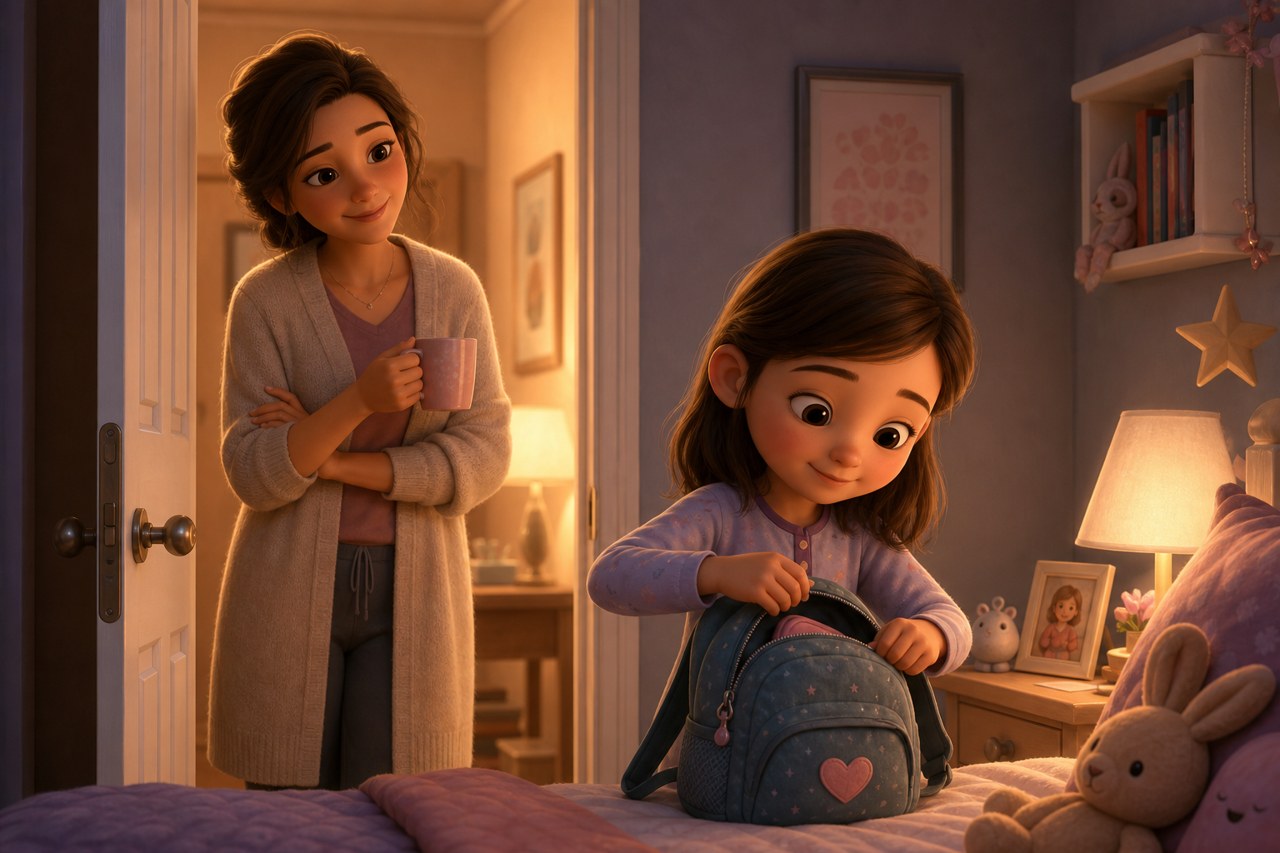
It's 11pm and you're checking the school supply list for the fourth time.
The backpack is packed. The forms are signed. Your child, notably, is asleep — peaceful, unbothered, possibly drooling. You're the one lying awake running simulations: What if no one sits with her at lunch? What if the teacher doesn't get him? What if this is the year the world gets its hands on my kid?
Here's the sentence nobody puts on the back-to-school checklists: a lot of back-to-school anxiety in the house belongs to the parents. And because children are exquisitely tuned instruments for their parents' emotional weather, your unexamined August dread has a way of becoming their September stomachache.
This isn't a guilt trip. It's the opposite — it's permission to look at the thing directly, name what it's actually about, and put it down before it gets handed to a six-year-old.
Why does back-to-school season make parents anxious? Because it isn't really about school. September is a yearly, scheduled loss of control: for seven hours a day, someone else's voice shapes your child, someone else handles the fall on the playground, someone else decides whether they're seen. For parents who carry their own school wounds — the year they were invisible, the teacher who shamed them — it also quietly reactivates old memories. The anxiety is real, but its subject is usually control, time, and your own history. Not the supply list.
What your anxiety is actually about
Pull the August dread apart and it's rarely one thing:
Loss of influence. All summer, you were the primary voice. Now your child spends most waking hours in a room where you have no vote. The whisper underneath: have I put enough into them to survive contact with everything else?
Your own school story. For some of us, school hallways hold our oldest wounds. Watching your child walk into one can reactivate feelings that are decades old and wearing your child's face. It's worth asking bluntly: am I afraid for my child, or am I remembering being me?
Time. Kindergarten drop-off, new grade, last first-day-at-this-school — every September is a visible click of the ratchet. Some of the ache isn't fear at all. It's grief in a hurry, and it deserves to be called by its name.
The world. And some of it is legitimate: the internet is real, cruelty is real, the pressures kids face are real. Fair. But legitimate fear still can't be handed to the child to carry. It's fuel for your preparation, not their send-off.
Why this matters for your child
Children read state, not speeches. Long before they process what you say about school, they've absorbed how your body feels about it — the tight voice at breakfast, the third "are you SURE you're okay?", the hug that lasts a beat too long and grips a little like goodbye.
Anxiety researchers call it co-regulation: a child's nervous system calibrates against the nearest trusted adult's. It's why "borrow my calm" works at bedtime — and why the reverse works too. A child who is repeatedly asked whether they're nervous will eventually conclude they're supposed to be.
The tell is in the questions. "Were the kids nice to you?" "Did anyone play with you at recess?" "You'd tell me if something was wrong, right?" — asked often enough, these stop being questions and become weather reports: my parent scans this sky for storms, so storms must be likely.
What to do with it (instead of handing it over)
Name it, specifically, to an adult. Not "I'm a little stressed" — the real thing: "I'm afraid she'll be invisible, because I was." Spoken to your spouse, a friend, or God at 11pm. Anxiety named shrinks; anxiety unnamed leaks.
Separate the fear from the forecast. Your fear is information about you, not a prophecy about them. Your child is not you. They're walking in with something you may not have had — a parent doing this work on purpose.
Give your worry a container. You will worry — fine. Decide when. Pray at the kitchen counter after drop-off. Journal Sunday nights. A container keeps worry from becoming the household's background radiation.
Do your preparation offstage. Vet the school, email the teacher, have the internet-safety conversations — all of it. Just do it out of your child's earshot. Preparation is a parent's job; the awareness of everything being prepared against is not a child's.
Watch your questions at pickup. Swap the anxiety audit for presence: "There you are. I thought about you today." Then let them talk, or not. You'll learn more from their unprompted chatter than from any interrogation — and they'll learn the day ends in belonging, not evaluation.
Hand the fear somewhere sturdier. This is where faith stops being decoration and starts being load-bearing. You were never going to be able to follow them into the classroom. But you have never been the only one watching your child. "I trusted God with them at 11pm so I didn't hand them my fear at 7am" is a real, practical parenting move — maybe the most practical one in this article.
The blessing that replaces the worry
Anxious energy wants an outlet at the door. Give it a better script than "are you sure you're okay?" Three sentences, said like you mean them:
- "You are ready for this."
- "Whatever today brings, you come home to people who love you."
- "God goes with you — you're never in that building alone."
Then the short goodbye, the confident walk away, and the car cry if you need it. (You get to have the feelings. You just don't get to send them to school with a child.)
The September truth
You are not anxious because you're a bad parent. You're anxious because you love someone more than you can supervise them — which is the permanent condition of parenting, arriving every August on a yellow bus.
The goal was never to feel nothing at drop-off. It's to make sure that of everything you've packed for them — the lunchbox, the forms, the spare mask of confidence — the thing they actually carry into the building is the identity you've been speaking over them all along: loved, ready, never alone.
Let the worry stay in the car with you. It was yours anyway.
Keep going
- Bedtime Affirmations for Kids: 25 Phrases That Build Identity and Calm Anxiety — half of these calm the parent saying them, too.
- The Week Two Drop: What to Say When School Suddenly Gets Hard — when the anxiety turns out to be theirs after all.
- Raising Secure Kids in the Age of TikTok — for the legitimate-fears list.